

Turn your patent specification into drawings you can edit
Paste your spec (up to about 3,000 words), get USPTO-style draft flowcharts and block diagrams you edit like a document. Reference numerals are cross-checked against your spec, and the sheets are checked against the measurable rules of 37 CFR 1.84. A patent professional should still review them before filing.
Filing on your own? Describe your invention in plain English. PatentQuill numbers every part for you and gives you a matching figure description to paste into your application.
Distributed system with search engine and account management servers · US 6,269,361 B1, FIG. 1
1. Quoted source text (verbatim input)
The block diagram of FIG. 1 therefore shows a distributed system 10 comprising a plurality of client computers 12, a plurality of advertiser web servers 14, an account management server 22, and a search engine web server 24, all of which are connected to a network 20. The network 20 will be hereinafter generally referred to as the Internet. Although the system and method of the present invention is specifically useful for the Internet, it should be understood that the client computers 12, advertiser web servers 14, account management server 22, and search engine web server 24 may be connected together through one of a number of different types of networks. Such networks may include local area networks (LANs), other wide area networks (WANs), and regional networks accessed over telephone lines, such as commercial information services. The client and server processes may even comprise different programs executing simultaneously on a single computer.
The client computers 12 can be conventional personal computers (PCs), workstations, or computer systems of any other size. Each client 12 typically includes one or more processors, memories, input/output devices, and a network interface, such as a conventional modem. The advertiser web servers 14, account management server 22, and the search engine web server 24 can be similarly configured. However, advertiser web servers 14, account management server 22, and search engine web server 24 may each include many computers connected by a separate private network. In fact, the network 20 may include hundreds of thousands of individual networks of computers.
US 6,269,361 B1, detailed description, two contiguous paragraphs describing the distributed system of FIG. 1
2. Generated by PatentQuill
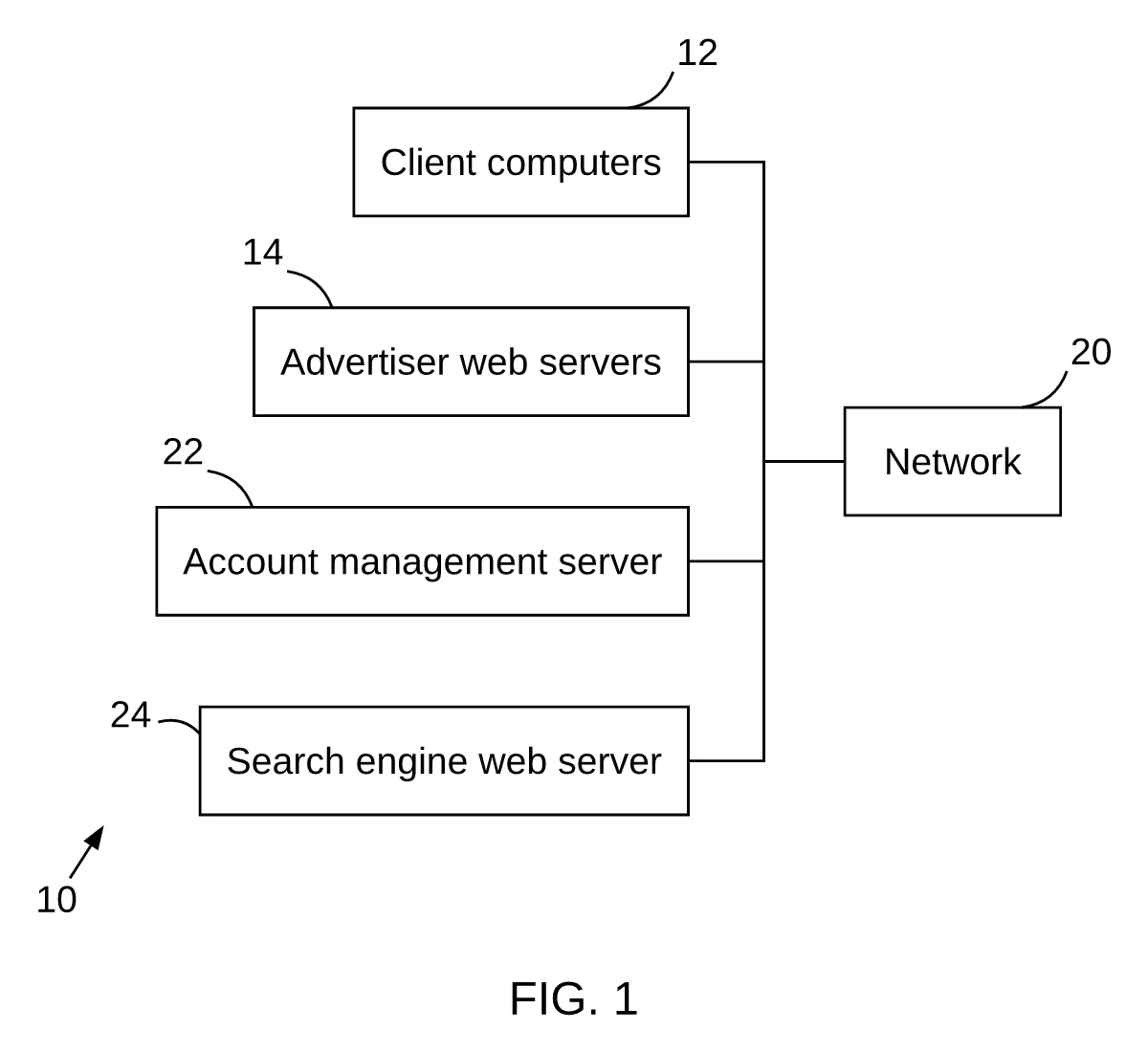
Source: US 6,269,361 B1, FIG. 1. US 6,269,361 B1, detailed description, two contiguous paragraphs describing the distributed system of FIG. 1. Generated by PatentQuill from the quoted public patent text; unedited.
Sheet check: all 12 rules passed (37 CFR 1.84 measurable rules).
How it differs from the official figure: The official FIG. 1 also shows a browser 16 on each client computer and storage 32 in the account management server, which this passage mentions only in general terms; the generated figure omits them and draws the four computer groups connected to network 20. The reference numeral 10 labels the whole system and is drawn as an arrow in the official figure. Cross-check found no issues. Compliance checks all passed.
From paragraph to drawing sheet
A form, not a chat. You stay in control of every word on the sheet.
Paste the text you already wrote
A paragraph of the detailed description, a method claim or a list of modules, up to about 3,000 words. Choose flowchart, block diagram or both, and S100 or 200-series numbering.
Get a drawing built from your words
Steps and modules are taken from your text, labelled with your wording and laid out on a ruled sheet. Every box is tied to a source sentence; when your text gives no numeral, the engine assigns one and the cross-check lists it, and anything not found in your text is flagged.
Fix it like a document, then file it
Click a box to change its words or numeral; only that box moves. Export US Letter or A4 PDF sheets, SVG, or 300 dpi PNG. Edits never use a credit.
What it replaces
Software and method drawings are usually sent to an outside draftsperson. For flowcharts and block diagrams, that round trip is the slow part.
Published price
Draftsperson$15–$150 per sheet
PatentQuill$0.33–$1.00 per figure
Change one box
DraftspersonEmail a markup, wait for the next round
PatentQuillClick the box and type; free
Numerals vs. your spec
DraftspersonYou proofread by hand
PatentQuillChecked both ways; mismatches are listed in the cross-check report
Files you get
DraftspersonUsually PDF or TIFF
PatentQuillPDF sheets, SVG, PNG at 300 dpi
PatentQuill prices from the pricing page: $0.33 on the yearly Firm plan to $1.00 in the smallest pack ($0.67 in the largest). Outsourced range: published per-sheet prices of six services, checked 2026-11-11, with sources on patent drawing cost. Outsourced prices are per sheet; a PatentQuill credit is one figure, and a sheet can hold several, so they are not like for like.
Built to 37 CFR 1.84
Every sheet is checked against the measurable USPTO drawing requirements before you export it.
- Margins§ 1.84(g)
- At least 2.5 cm top, 2.5 cm left, 1.5 cm right and 1 cm bottom on US Letter or A4. Content never crosses them, and drawings are reduced only while capitals stay at least 0.32 cm, otherwise split across sheets.
- Lettering§ 1.84(p)(3)
- Capital letters and numerals are at least 0.32 cm tall, measured on capitals on the final sheet in an embeddable sans-serif font.
- Black and white§ 1.84(a)(1), (l)
- Solid black lines of even weight on white. No color, no gray fills, no shading added for decoration.
- Figure labels§ 1.84(u)
- Each view is labelled “FIG. 1”, “FIG. 2” and so on, in order, below the drawing.
- Sheet numbers§ 1.84(t)
- Sheets are numbered “1/3”, “2/3” in the middle of the top of the sheet, inside the margins and clear of the drawing.
- Reference numerals§ 1.84(p), (q)
- Numerals sit inside flowchart steps or outside block diagram boxes with a lead line, never crowding the label.
Automatic checks cover what can be measured on the sheet. Whether a drawing shows every claimed feature remains the filer’s judgment.
Pay per drawing, not per hour
5 free credits when you sign in with Google. Credit packs never expire and cost $0.67–$1.00 a drawing; plans bring it down to $0.33, up to 50% less than the large pack. Editing is always free.
Questions
Something else? Write to us.
What kinds of drawings does PatentQuill make?
Method flowcharts (steps numbered S100, S102… or 200, 202…) and system block diagrams (modules numbered 100, 102… with lead lines) for US utility applications on software, methods and systems. It does not draw mechanical parts, design patents or drawings for other patent offices.
Will it add steps or modules that are not in my text?
No. Every box is tied to the sentence it came from. If a label cannot be found in your text, the box is flagged so you can fix or remove it before export.
How does the numeral check work?
PatentQuill reads the reference numerals in your text, such as “module 104” or “step S300”, and compares them with the drawing in both directions: numerals in the text but not on the drawing, on the drawing but not in the text, duplicates, and one numeral used for two different names. Each mismatch is listed and marked in red on the sheet.
Do edits use credits?
No. Changing text, numerals, arrows or position is free. A credit is used only when a drawing is generated or regenerated from your text.
Are the drawings accepted by the USPTO?
Sheets are produced to the measurable requirements of 37 CFR 1.84 (margins, letter height, black solid lines, figure labels, sheet numbers) and checked before export. Acceptance also depends on content, such as showing every claimed feature, which stays your call.
What can I try for free?
5 free credits (about 1–2 complete drawings) when you sign in with Google, with full editing and the numeral check. Accounts created with an email code start with no free credits. Free exports carry a watermark; paid exports are clean sheets with a cross-check report.
Is my application text kept confidential?
Your text and drawings are stored in your account and used to generate and save your drawings. To make a drawing, the text you submit is sent to outside AI processing services. Our staff do not view your project content unless you authorize it for a support request. You can delete any drawing at any time, or ask us to delete your account, and its data is removed within 30 days. If your application is unpublished, read the privacy policy before you paste its text.
Do you use my text to train AI?
No. We never use your text, drawings or edits to train AI models. Your text is sent to AI processing services only to generate your drawing; our privacy policy describes these services by category and what each category receives.
Is this legal advice?
No. PatentQuill is a drafting tool, not a law firm. It does not review claims or advise on patentability.
Draw FIG. 1 before your next call
5 free credits with Google sign-in. Email-code accounts start with none.